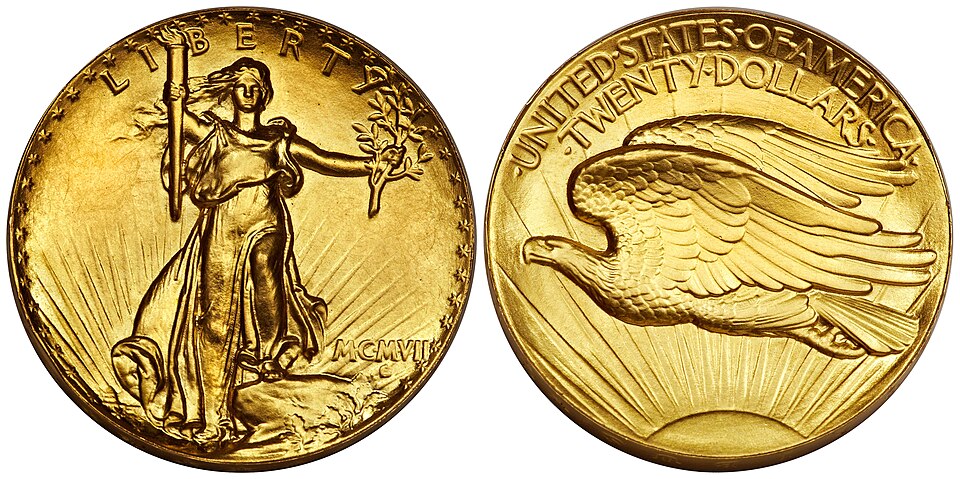
From the Coinage Act of 1792 until President Franklin D. Roosevelt signed Executive Order 6102 on April 5, 1933, the United States Mint struck circulating gold coins in denominations ranging from the tiny $1.00 Gold Dollar up to the massive $20.00 Double Eagle. Standard circulating U.S. gold coins minted from 1837 through 1933 were struck in an alloy of 90% pure gold (.900 fine) and 10% copper (or copper-silver alloy) to resist pocket wear.
In Knoxville and across East Tennessee, pre-1933 U.S. gold coins are among the most prized items uncovered during estate settlements. Knowing the exact Actual Gold Weight (AGW) of each denomination—and knowing which Southern branch mint marks carry massive numismatic premiums—can mean a difference of thousands of dollars when you sell.
Exact Pure Gold Content (AGW) Chart for Pre-1933 U.S. Gold Coins
Unlike modern 1 oz American Gold Eagles (which contain a full 1.0000 troy oz of pure gold), pre-1933 U.S. gold coins were sized so that $20.67 face value equaled 1.0000 troy ounce of pure gold under the classic gold standard. Consequently, a $20 Double Eagle contains 0.9675 troy ounces of pure gold:
| U.S. Gold Coin Denomination | Design Series & Years | Gross Weight (Grams) | Purity | Pure Gold Content (AGW in Troy Oz) |
|---|---|---|---|---|
| $20.00 Double Eagle | Liberty Head (1849–1907) & Saint-Gaudens (1907–1933) | 33.436 g | 90.0% (.900) | 0.96750 ozt |
| $10.00 Eagle | Liberty Head (1838–1907) & Indian Head (1907–1933) | 16.718 g | 90.0% (.900) | 0.48375 ozt |
| $5.00 Half Eagle | Liberty Head (1839–1908) & Indian Head (1908–1929) | 8.359 g | 90.0% (.900) | 0.24187 ozt |
| $3.00 Indian Princess | Indian Princess Head (1854–1889) | 5.015 g | 90.0% (.900) | 0.14512 ozt (+ High Rarity Premium) |
| $2.50 Quarter Eagle | Liberty Head (1840–1907) & Indian Head (1908–1929) | 4.180 g | 90.0% (.900) | 0.12094 ozt |
| $1.00 Gold Dollar | Liberty & Indian Princess Types I, II, III (1849–1889) | 1.672 g | 90.0% (.900) | 0.04837 ozt (+ Collector Premium) |
Before buying or liquidating coins and bullion in Tennessee, verify exact troy weight and dimensions at home with a 0.01g Digital Troy Ounce Scale, a Bullion Acoustic Ping Tester & Digital Caliper, or a non-destructive Precious Metal Verifier.
Watch for Southern Branch Mint Marks: Dahlonega (D), Charlotte (C), and New Orleans (O)
Because Knoxville sits just north of the Georgia and North Carolina Appalachian gold fields, East Tennessee family estates occasionally hold pre-Civil War $1, $2.50, and $5 gold coins struck between 1838 and 1861 at two historic Southern branch mints:
- Dahlonega, Georgia (
Dmint mark, 1838–1861): Notice that aDmint mark on a gold coin dated 1838 to 1861 stands for Dahlonega, Georgia (whereas aDon a coin dated 1906 or later stands for Denver, Colorado). Any genuine Dahlonega gold coin commands a collector value far exceeding its gold melt weight! - Charlotte, North Carolina (
Cmint mark, 1838–1861): Struck solely in gold denominations ($1, $2.50, and $5), Charlotte branch-mint coins are scarce historical treasures of Southern Appalachian numismatics.
Never clean, buff, or wipe an old gold coin—even rubbing a coin with a soft cloth leaves microscopic hairline scratches that can reduce a coin's numismatic grade from Mint State (MS) to "Uncirculated Details - Cleaned." Bring your coins in their existing holders for a professional numismatic and bullion evaluation in Knoxville, or read our Knoxville Gold Coin Selling Guide.